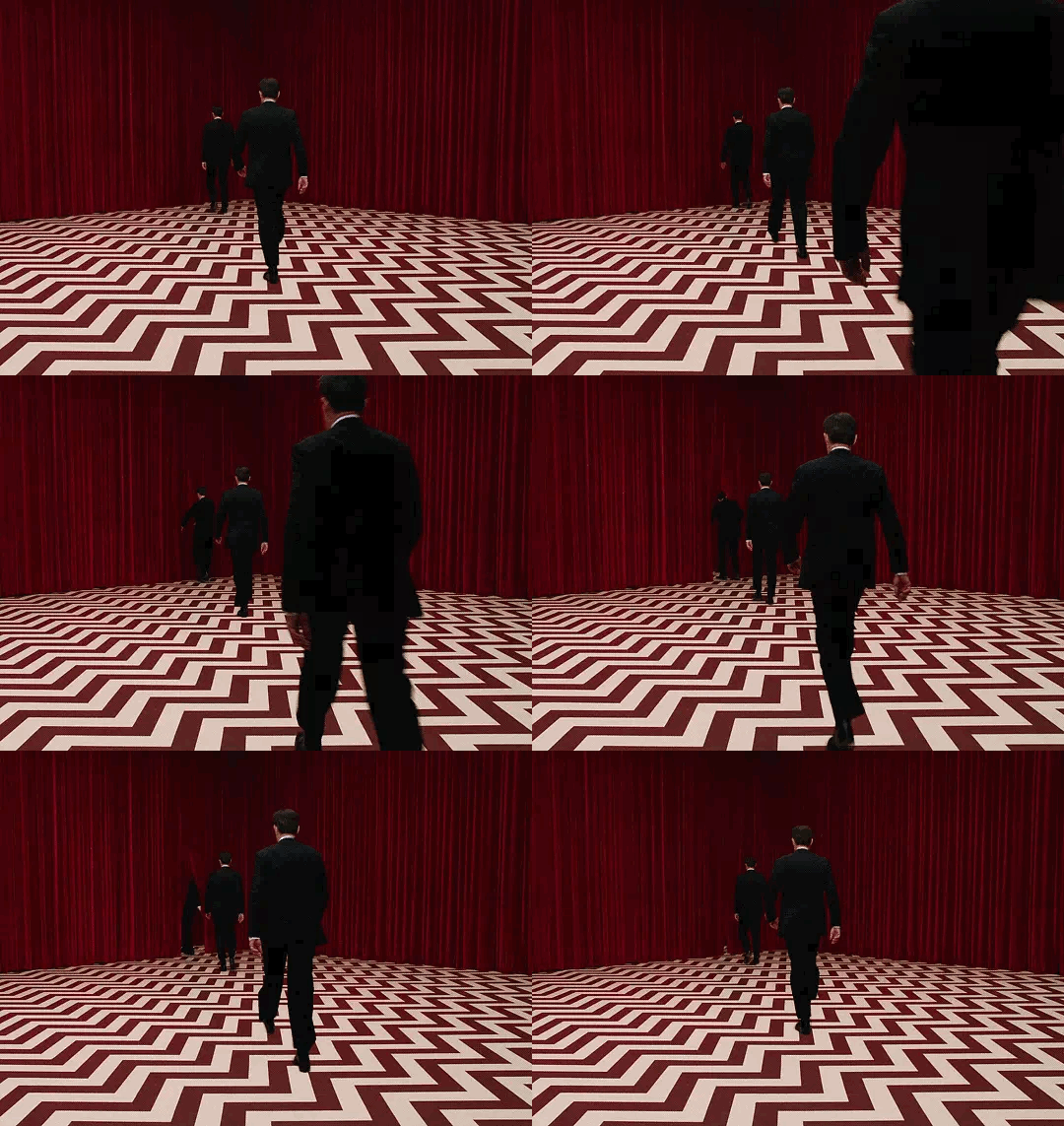
I’ve got good news. That gum you like is going to come back in style.
- The Man from Another Place
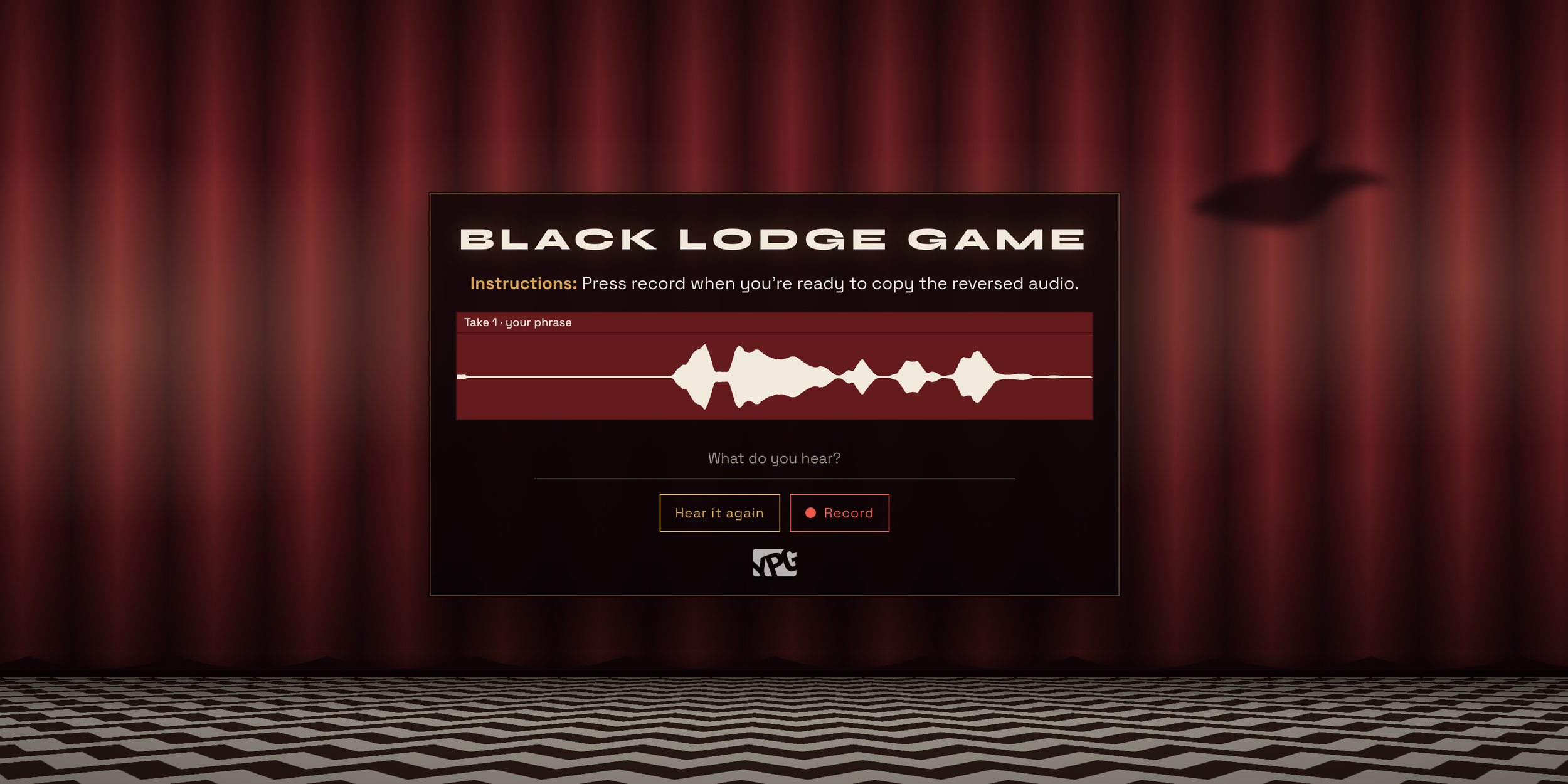
Play The Black Lodge Game at youngproducersgroup.com/black-lodge-game.
Special agent Dale Cooper sees the Black Lodge for the first time in the second episode of “Twin Peaks,” David Lynch’s classic TV show from the early 90’s. He’s dreaming. The Man from Another Place is dancing in the Red Room and Laura Palmer, the subject of his murder investigation, is there too, but 25 years older. It’s not until the series finale that he physically enters the Black Lodge. He’s led to a circle of twelve sycamore trees with a pool of oil in the center. He hears an owl, red curtains appear, and he walks in. He does not walk out for another 25 years.
The sound of the Black Lodge is just as iconic as its red curtains, chevron floor, marble statues, and moving shadows. Here’s how Lynch did it:
Actors said their lines into a tape recorder (it was the 90’s)
They played the tape in reverse
They learned how to say their lines backwards phonetically
Lynch shot the scene and actors said their backwards lines
The editor reversed the footage, reversing back the actor’s lines to “normal.”
What comes out the other side is distinctive and warped, lending to the Red Room’s surreal, unsettling air. You understand what they’re saying (sometimes with the help of subtitles), but their voices are bent with inflections that don’t read as human speech. Here Lynch uses a tool as old as audio itself, reversing, to transport viewers to the spirit realm.
Black Lodge, But Make it a Game
I saw the potential for an audio game as soon as I learned of Lynch’s Black Lodge trick. I led students through it when I was still teaching and encountered something I hadn’t fully expected: laughs. Lots of laughs. Steps 3 and 4 are what really do it. Just listening to reversed audio of speech is funny, but copying the phonemes and saying it along will make just about anybody crack up. After playing this game a few times, I saw what I had actually created: a class culture-building, slate-wiping, recentering tool for the classroom. Sure, it teaches students about audio and listening, but more than anything, it’s a plain, old good time.
Watch this post on instagram to hear how goofy I sound saying the reversed version of “I’ve got good news.”
Playing it with students is simple. Follow these steps:
Ask the class for a short phrase.
Call up a student to record that phrase.
Reverse it.
Transcribe what you hear with the class.
Call up another student to say the reversed version.
Reverse it back to “normal.”
For years, I would play this game with whatever DAW was in front of me. I built a Twin Peaks-style player so that anybody can enter the Black Lodge, DAW or not. The player needs microphone access to work. But teachers, don’t worry: nothing is uploaded and nothing is saved. Your students’ recordings live in the browser tab and vanish when it closes.
After many years of playing the Black Lodge Game, here are a few key tips:
Keep your phrase to 3 or 4 words long
Say the phrase clearly and loudly during recording
Slow down the audio after it’s been reversed to make it easier to understand (we made it .5x speed in the player)
Write down phonetics of the reversed audio. It’s easier than memorizing the audio on its own.
Pay close attention to the inflections of the reversed audio. The closer you match your inflections to the reversed audio, the more it will sound like the original.
As always, be generous with the applause. Students are going out on a limb getting in front of the class and saying gibberish. Gas them up for it.
Try it for yourself below:
Black Lodge Game
Instructions: Say “Black Lodge” or hit space bar, then record a short phrase.

Project Fatigue Relief
Project-based learning is at the core of the Young Producers Group pedagogy. The best way to learn about something is to actually do it, especially within a group of equally-motivated, open-minded peers. Even with the inclusive, modern, culturally-sustaining projects that define YPG’s learning materials, students eventually hit a wall. Project, listening party, project, listening party, project, listening party, sooner or later, project fatigue sets in. You gotta mix it up and keep things fresh in the classroom. Games offer a potent remedy, especially those that are whole-class and unserious.
A good game pulls students out of their headspace and redirects energy to new places. Music production can be isolating. Our students are all alone in their headphones, lonely audio stars within the larger constellation of their peers in the classroom. It’s only at listening parties that they get signs of life from the others. A game shakes up the structure and changes the energy in the room.
The deep lols will refresh your students’ ears and lift their spirits. A few rounds of the Black Lodge Game in the middle of class will help students lock in for the rest of the period, guaranteed.
Reversing Revisited
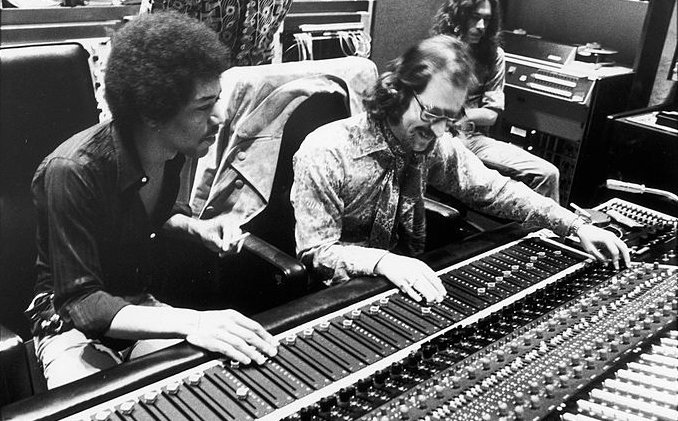
Jimi Hendrix and producer Eddie Kramer in the studio.
In an era where AI can turn your voice into a saxophone or create an entire song from a simple prompt, it’s easy to forget about the big audio bang you can get for the buck of simple tricks. The humble reverse button can take a quotidian sound and instantly flip it on its head. The Beatles, Jimi Hendrix, and other classic rockers used the tape machines of their time to reverse guitar recordings, slipping into the psychedelic.
The Beatles and Led Zeppelin were both accused of utilizing a technique called backmasking to encode secret messages into their records. And I do mean records. Because vinyl could be played backwards, listeners at home ran the records in reverse and reported hearing “Paul is a dead man, miss him, miss him, miss him!” or “Here’s to my sweet satan.” Both bands denied putting any secret messages in their music after being the subject of congressional hearings. Backmasking is distinct from what’s going on in the Black Lodge because backmasked messages are designed to be played in reverse to reveal their contents.
An article on the magic of reversed media would be incomplete without a mention of the classic Spike Jonze video for the Pharcyde’s 1995 track “Drop.” Spike channeled David Lynch and had the four rappers learn their lines phonetically backwards, shot the whole video, and then reversed it. Jonze described in a podcast hiring a UCLA phonetics professor to transcribe the backwards lyrics and hold them up as cue cards during shooting. They squeeze a lot of juice from the simple trick: the rappers magically lift up from the ground as bikes drive by backwards, balls bounce up stairs, and water sucks up into the sky from puddles. Enjoy:
In Conclusion (Or to Begin)
The Black Lodge Game has two important lessons for students and teachers alike:
1. Making Media is Magic
Artists like David Lynch, Spike Jonze, Jimi Hendrix, etc. leverage their creative tools to transport us to the land of dreams, psychedelia, and all things fantastic. With Soundtrap available to any student with a Chromebook and Ableton Live available to schools for free, we all have the power now to perform our own magic tricks. Whether it’s reversing, time stretching, pitching, processing, or any other form of audio sleight of hand, we all have the tools to enter our own Black Lodge. We’ll see if, like Agent Cooper, you ever make it out.
2. The Importance of Play
Making music should be fun. Of course, sometimes it’s not. Sometimes it’s a slog, a frustrating, insecurity-flaring, tedious slog. Playing games like the Black Lodge Game changes the energy in the room as I described, but they also reconnect us to a playful mindset. Experimenting, finding flow, and having fun are much easier when you’re approaching the studio as a playground instead of an office.
And whether you play games in your class or not, I’ve got good news: That gum you like is going to come back in style. See you in the Black Lodge!