
Students develop essential music literacy skills by listening to and writing about the music they love.
Grades: 6-12
Software: Soundtrap (Chromebook, Mac, PC)
Cost: $750/year
Get FREE access to Unit 2, “The Way Sound Sounds,” and explore the Music Appreciation curriculum in your classroom.
Music Appreciation
Curriculum Overview
This engaging curriculum invites students to analyze the music they enjoy while exploring how sound, culture, and society are deeply connected. Designed for students with little to no prior music background, the course builds musical literacy by helping students understand the sounds, ideas, and contexts that shape the music they encounter every day. Along the way, students develop critical listening skills and a deeper appreciation for music as both an artistic and cultural practice.
The Music Appreciation curriculum is organized into thematic units that include Key Concept Videos, readings, guided listening activities, glossaries, assessment questions, and prompts for class discussion. By the end of the curriculum, students are equipped not only to talk and write about music with confidence, but also to engage more intentionally with their musical communities, and, for many, to take their first steps toward creating music of their own.
-
Learn to recognize sounds as high, mid, or low, and explore how these combine as layers to form complete pieces of music.
-
Focus on describing the qualities of sound, pure tones like sine waves with noisy sounds like white noise, and explore how everything in between shapes the textures we hear in music.
-
Analyzing musical terms like dynamics, rhythm, and tempo, including the word music itself.
-
Understanding musical form and the function of the different sections within a traditional pop music structure.
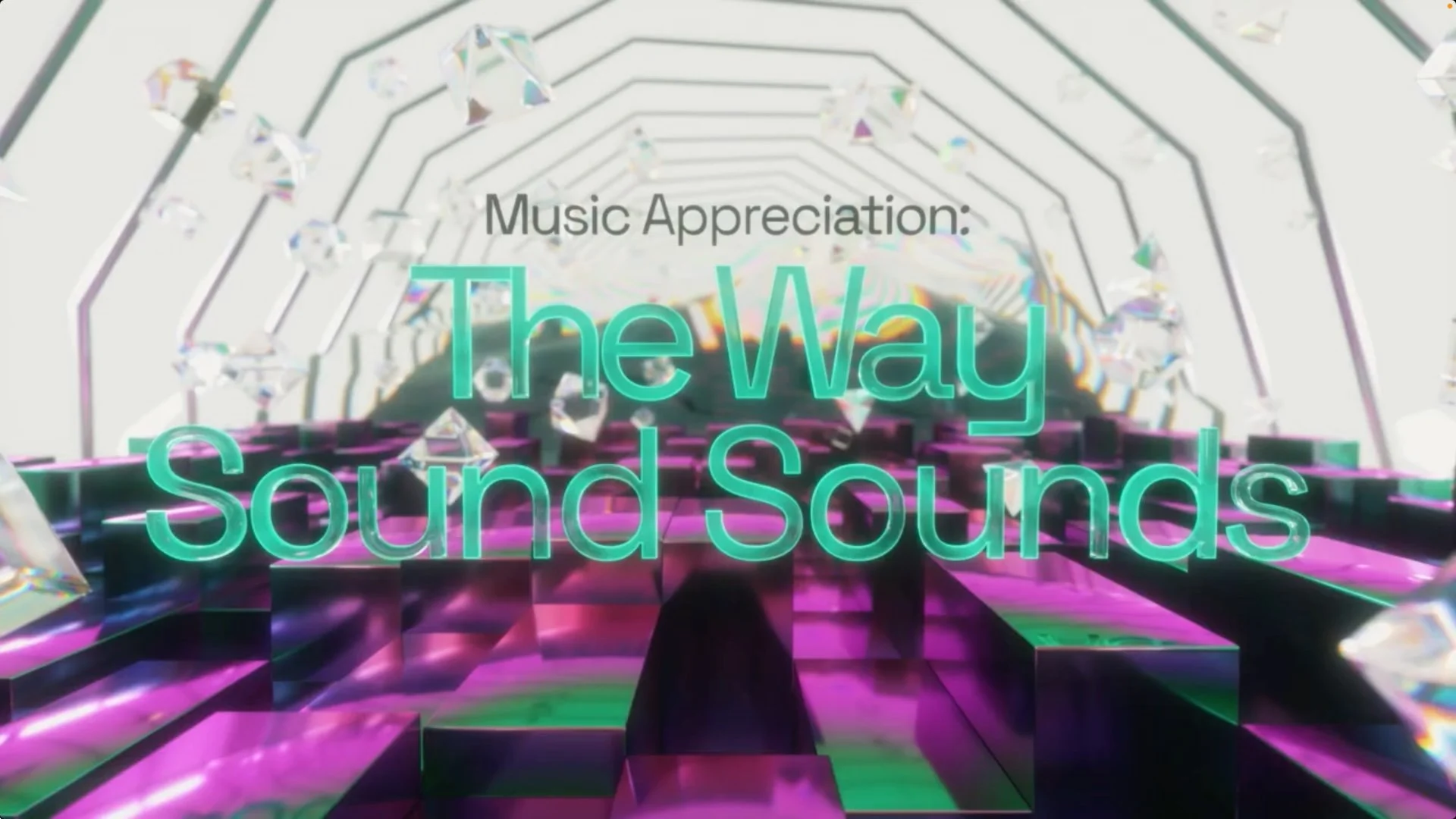
Key Concept:
The Way Sound Sounds
In this video from Unit 2, The Way Sound Sounds, students explore how different frequencies combine to create complex sounds. By comparing sine waves, white noise, voices, and instruments, the video introduces timbre as the quality that allows us to hear differences between sounds even when they share the same pitch.
Key Concept:
The Language of Music
In this video from Unit 3, Language of Music, students explore how pitch is used to create melody and harmony in music. Melodies are introduced as sequences of notes, while harmony is defined as multiple notes played together, including intervals, chords, and chord progressions that shape a song’s emotional impact.

Unmatched Teacher Resources & Support
Teachers receive a comprehensive, digital Teacher’s Handbook to help set up and maintain a productive atmosphere where students feel safe to explore their creativity, respond to peers’ work, and connect their projects to the world around them.
The handbook includes:
Detailed pacing guide
Grading rubrics for each assignment
Pedagogy guides
In-depth, grade-specific instructional techniques